

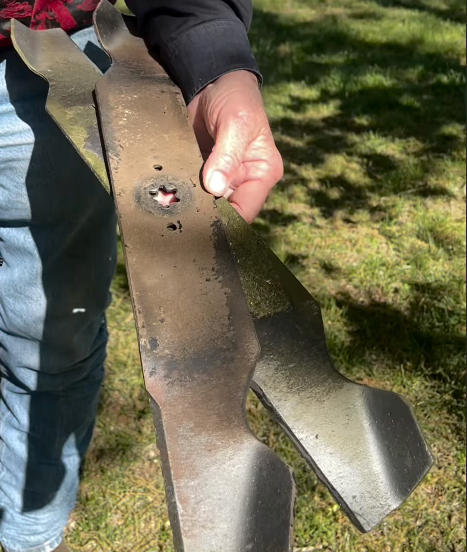
Mower vibration is one of those problems that most people learn to live with rather than solve. The mower starts up, there is a subtle rattle or shake coming through the handles or the seat, and the instinct is to figure it is just how the machine runs. Maybe it has always done that. Maybe it is a little worse than it used to be. Either way, the lawn needs to get cut, so the session starts and the vibration gets ignored for another week.
What is actually happening during those sessions is not something that can be safely ignored. Mower vibration is not a quirk of how the machine sounds or feels. It is a symptom of a mechanical imbalance in the cutting system that is transmitting stress into the spindle assembly, the deck structure, and the bearings with every minute of operation. The longer it runs, the more damage accumulates. And the source of that imbalance almost always comes back to the same place: the metal blade.
Where Mower Vibration Actually Comes From
A metal blade has to be perfectly balanced to run without vibration at operating speed. That balance is established when the blade is manufactured, and it depends on the metal being distributed evenly across both sides of the cutting edge. When a blade is new and undamaged, that balance exists and the mower runs smoothly.
That balance does not last.
Every time a metal blade makes contact with a rock, a root, a buried piece of debris, or anything harder than grass, the impact has the potential to alter the blade's mass distribution. A small chip on one cutting edge. A slight bend from a hard strike. An area of the blade that wears faster than the other side during a sharpening session where one pass went slightly deeper than intended. Any of these changes, even ones too small to see clearly with the naked eye, create an imbalance in the blade that shows up as vibration the moment the mower reaches operating speed.
Most homeowners sharpen their own blades without professional balancing equipment, which means every sharpening session carries a genuine risk of introducing imbalance even when the sharpening itself goes well. A blade that takes two passes on one side and one on the other is now heavier on one side, and a heavier side spinning at thousands of RPM becomes the source of mower vibration that transmits into every connected component with every rotation.
What Mower Vibration Does to Your Equipment Over Time
The mechanical consequence of running a mower with an imbalanced blade is cumulative and progressive. It does not announce itself with a single failure event. It shows up gradually as components that were designed for smooth rotational load begin absorbing the additional stress of an imbalanced cutting system operating at speed.
Spindle bearings are the first components to feel it. Bearings are engineered to handle the axial and radial loads of a balanced blade spinning at operating speed. Mower vibration from an imbalanced blade adds a cyclical shock load to that equation with every rotation. Over hundreds of hours of use, that repeated shock loading accelerates bearing wear in a way that goes beyond normal use degradation. The bearing that should have lasted ten seasons starts showing wear by season five. By season seven it is generating its own noise, and by the time most owners trace the problem back to the spindle, the repair cost is meaningful.
Beyond bearings, mower vibration transmits through the deck structure itself. Decks are built to handle the stress of normal operation, but chronic vibration from an unbalanced blade creates micro-stresses in the welds, brackets, and mounting points that accumulate over time. Bolts loosen. Welds develop fatigue cracks. Structural points that were solid when the mower was new become sources of additional noise and movement as the years go by.
For operators who run their mowers for long sessions across large properties, the total hours of vibration exposure compound these effects faster. A commercial landscaping crew running a machine for six hours a day is accumulating vibration stress at a rate that a weekend residential mower simply does not, and the maintenance record of their equipment reflects that difference.
Why the REVO6 2.0 Hub Eliminates Mower Vibration at the Source
The REVO6 2.0 hub was engineered with balance as a core design principle, and the way it achieves consistent balance is fundamentally different from anything a metal blade system can offer.
The hub is perfectly balanced regardless of how many REVOlines are installed at any given time. Whether all six lines are in place or the system is running on fewer lines because some have worn through during a session, the rotational balance of the hub itself does not change. The design accounts for this from the ground up, which means the mower never experiences the vibration profile that comes from an asymmetric cutting element running at speed.
This is a significant departure from the reality of metal blade operation. A metal blade with one chip on one side is unbalanced. A metal blade sharpened slightly more aggressively on one edge is unbalanced. A metal blade that bent slightly after a rock strike and was straightened back by hand is almost certainly unbalanced. The margin for error that keeps a metal blade running without vibration is extremely narrow, and normal use erodes that margin constantly.
The REVO6 hub has no margin to erode. You will never feel mower vibration from the hub being out of balance. You will never hear the rattle that comes through a frame when an imbalanced metal blade reaches operating speed. The system runs smooth from the first pass of the season to the last, and the spindle assembly underneath it is protected from the cumulative shock loading that an imbalanced blade generates across hundreds of hours of use.
What a Vibration-Free Mowing Session Actually Feels Like
For anyone who has only ever operated a mower running a metal blade, the difference that comes from eliminating mower vibration at the cutting system level is immediately noticeable and sometimes surprising.
The machine feels quieter because it is quieter. Mower vibration generates noise as it transmits through the frame, the handles, and the deck components. When the source of that vibration is removed, the noise profile of the mower changes. Operators who make the switch consistently describe the REVO6 as running noticeably quieter than their previous metal blade setup, and a significant part of that difference comes directly from the elimination of imbalance-driven vibration.
For operators running long sessions across large properties or commercial routes, the reduction in vibration also reduces operator fatigue. Holding a vibrating handle or sitting on a vibrating seat for three to four hours is physically taxing in ways that most people accept as part of the job. When the vibration goes away, so does a meaningful portion of the physical effort that mowing at scale requires.
The Fix That Starts With a Single Component Swap
The REVO6 is available in residential, suburban, rural, and commercial packages at safemowing.com. Every package installs using the same bolt or nut that holds the existing metal blade. No special tools. No modifications to the machine. The hub goes on, the lines seat with a finger and a thumb, and the mower runs on a perfectly balanced cutting system from the first pass.
Every REVO6 2.0 hub carries a lifetime warranty, and the system is backed by a 90-day money-back guarantee.
Mower vibration has a source, and that source is the metal blade. Removing the metal blade removes the vibration, protects the spindle, and makes every mowing session from here forward fundamentally different from every one that came before it.

 https://safemowing.com
Share and get 15% off!
Simply share this product on one of the following social networks and you will unlock 15% off!