

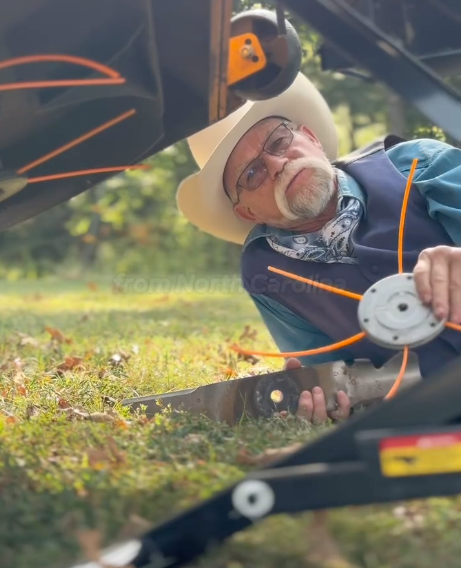
Running a landscaping business means managing a set of variables that most people outside the industry never think about. Equipment that has to perform reliably across dozens of properties every week. Crews that need to move efficiently from account to account without unexpected downtime. Consumable costs that add up across an entire fleet over the course of a season. And at the end of every day, a standard of finished quality that keeps customers calling back next week.
Most of those variables come back to the equipment in some form, and most of the equipment problems a landscaping business deals with start the same way: a metal blade making hard contact with something it was not meant to hit, and everything that follows from that moment.
The REVO6 system does not change how a landscaping business operates from a scheduling or customer service standpoint. What it changes is the mechanical reality of what happens under the deck every time a mower rolls over something unexpected, and that change touches every part of the operation in ways that compound significantly across a full season and a full fleet.
What a Landscaping Business Actually Loses to Metal Blade Problems
The costs that a metal blade imposes on a landscaping business are easy to underestimate when you are looking at them one incident at a time. A bent blade here. A spindle repair there. A day where one mower is down and the crew has to rearrange the route. None of it looks catastrophic in isolation.
The picture looks different when you add it up across a full fleet over a full season.
Metal blades need to be sharpened every 20 to 25 hours of use under normal conditions, and commercial mowing conditions are rarely normal. Rocky properties, terrain with roots pushing up through the turf, gravel edges, hidden debris from the previous season — every account has its own version of the hard-object problem, and a commercial crew is hitting those conditions on every property, every day. Blades on a commercial operation wear and take damage faster than residential use alone would cause, which means the sharpening cycle runs more frequently, the replacement cycle runs faster, and the time pulling blades, taking them to a shop or grinding them in-house, balancing them, and reinstalling them adds up across every machine in the fleet.
Then there is the downtime. A blade that takes a significant hit during a workday does not always announce itself as a problem on the first pass. Sometimes the crew finishes the account, notices something is off, and the damage has already been done to the spindle by the time the blade comes off for inspection. A spindle repair on a commercial zero-turn is not a quick fix, and every day that machine is out of rotation is a day the business is running below capacity on a full schedule.
How the REVO6 Changes the Daily Operation of a Landscaping Business
The practical changes the REVO6 brings to a commercial landscaping operation start with what happens when the REVOline contacts a hard object instead of a metal blade.
The line deflects. The energy disperses. The spindle assembly does not take a shockwave. The mower keeps moving without interruption and the crew does not have to stop, assess damage, or make a mid-day equipment decision. That outcome, multiplied across every property on a full commercial route, reduces the number of unexpected interruptions to the workday in a way that becomes noticeable quickly after making the switch.
Beyond impact events, the maintenance cycle itself changes. There is nothing to sharpen. Nothing to balance. When a REVOline reaches the end of its service life, a crew member changes it in seconds with no tools required beyond what installs the hub. Under normal grass-focused mowing conditions, each line provides approximately nine hours of mowing before performance starts to decline. A commercial crew in the Southeast documented running two full weeks at approximately 20 yards per day before needing to change lines on either of their two stand-behind mowers. That is the kind of consumable longevity that changes how a business budgets for supplies and plans its maintenance schedule.
What Clients Notice When a Landscaping Business Switches to REVO6
One of the more telling data points about the REVO6 in a commercial context comes from customers, not operators.
A landscaping business owner who switched to the REVO6 for their operation reported that clients started asking what was being done differently because the lawns were coming out better than they had with metal blades. That reaction came without any change to the mowing schedule, the route, or the crew. The only thing that changed was the cutting system.
The reason is straightforward. Six cutting contact points per hub produce finer clippings than two. That means clippings that settle into the turf rather than sitting on the surface in visible clumps. The finished appearance of a lawn after a REVO6 pass is cleaner and more uniform than what most metal blade setups produce on the same property, and clients notice that difference even when they cannot articulate exactly what is different about it.
For a landscaping business competing for residential and commercial accounts, cut quality is the product. A system that consistently produces a better-looking finished lawn on every account, without adding any additional time to the job, is a competitive advantage that compounds across the entire client base over time.
The Fleet Math That Makes the Business Case
The REVO6 commercial lawncare package covers six hubs, which is the right configuration for a full zero-turn fleet setup. For a landscaping business running multiple machines, the initial investment in outfitting those machines covers the hub systems with a lifetime warranty, meaning the primary component of the cutting system never needs to be replaced. The ongoing cost is REVOline, which is a fraction of the cost of blade replacement and sharpening across the same period.
The fleet math starts with consumables. A business spending money every season on blade replacements, sharpening services, and balancing equipment across multiple machines replaces most of that expenditure with a predictable, simple line replacement cycle that any crew member can execute without specialized tools or skills. The time previously spent on blade maintenance goes back into productive mowing hours.
The bigger part of the math is equipment longevity. A fleet of commercial mowers that has been protected from repeated spindle impact loading by running flexible line instead of rigid metal is on a different maintenance trajectory than one that has been absorbing hard-object blade contacts for years. Spindle bearing life extends. Deck wear slows. The machines that were going to need significant repairs by year four are still running cleanly by year six because the cutting system has been doing its job every session.
For a landscaping business where equipment is a major capital investment and replacement costs are a real business planning consideration, that longevity difference is a meaningful financial factor.
The Landscaping Business Upgrade That Starts With One Machine
The REVO6 commercial lawncare package is available at safemowing.com along with residential, suburban, and rural configurations for businesses with mixed fleet needs. Every order is backed by a 90-day money-back guarantee and a lifetime warranty on the hub.
A landscaping business does not have to convert its entire fleet at once to see what the REVO6 delivers. Starting with one machine on the route and running it through a full season of commercial accounts is enough to see the maintenance difference, the cut quality difference, and the equipment protection difference firsthand before making a broader commitment.
One machine. One season. The results tend to make the rest of the fleet conversion an easy decision.

 https://safemowing.com
Share and get 15% off!
Simply share this product on one of the following social networks and you will unlock 15% off!